
The Paragons of the Shigue Migration
The Shigue utilize several varieties of combat frame, known commonly as Gauntlets, or, in the Selo’shig language: Cal’kaan (lit: Strong Fist). Rarely encountered outside the migrations themselves, these machines are most commonly deployed during aerial, orbital, and deep space operations where they can utilize an unmatched degree of maneuverability that far outpaces Hegemon interceptor craft, posing a dangerous vector for larger capital ships if allowed to break through countermeasures. On the ground, the Gauntlet sacrifices much of this maneuverability, serving as a kind of support vehicle intended to hold the line after deployment.
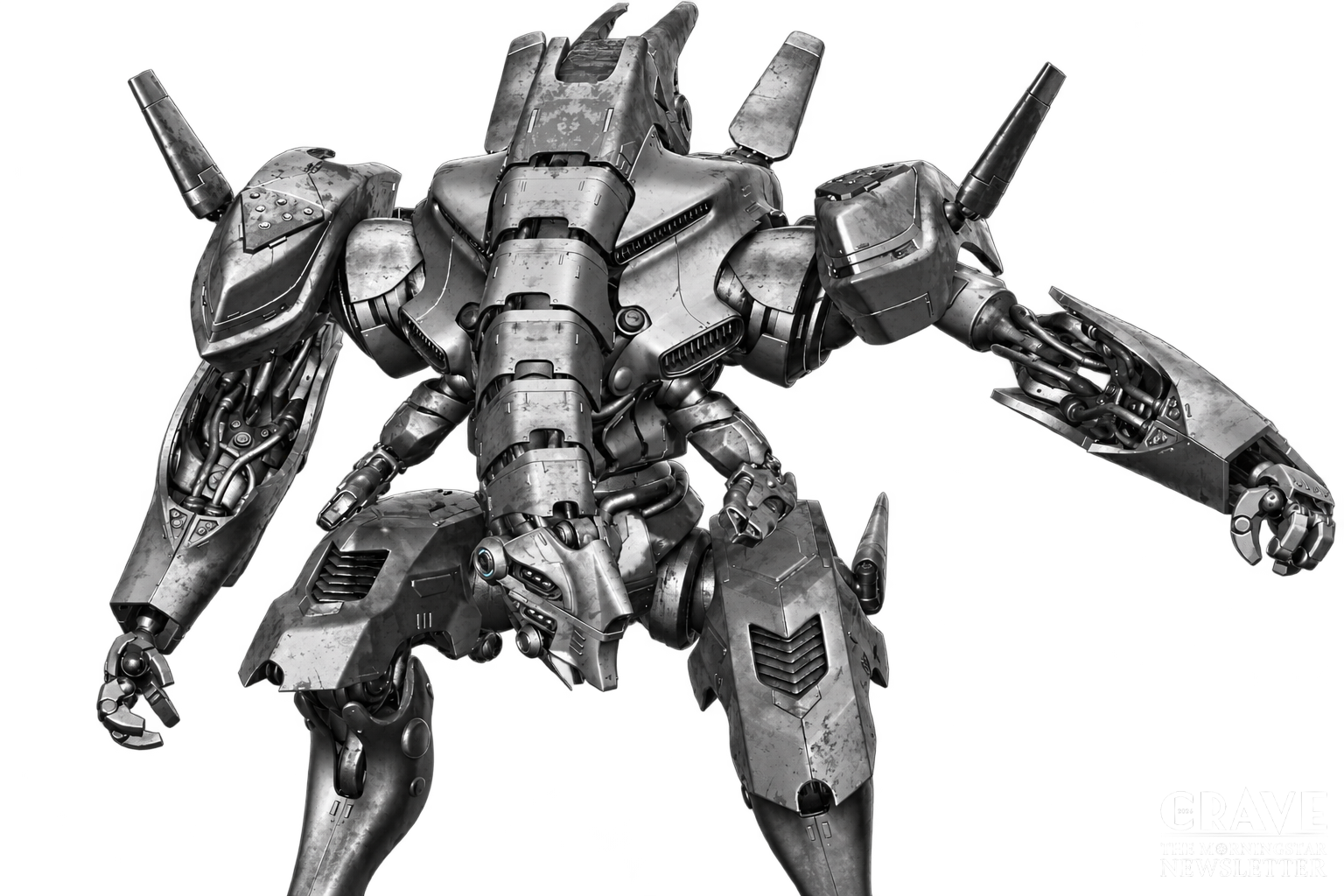
Directorate forces refer to the more common medium-class Gauntlet as “Hunchback”
Artist: Joazzz
The Gauntlet’s technology is derived from generations of Shigue adaptation to living in space. Similar in necessity to the Labor Mobility Units of the Hegemon, which allow pilots to operate in hostile environments and accomplish workloads impossible for single individuals, the early Gauntlets were for utility rather than military applications. Maintenance of starships the size of entire megacities required constant attention by workers that could flit from one problem to the next and possessed the dexterity to fix a range of issues.
As the Migrations entered into regions hostile to their presence, the Gauntlet took on a new role; defense. From these early constructs came further adaptations as encounters required the operator’s further integration with the physical frame in order to be effective as soldiers.
As the Shigue do not possess technology similar to the cogit-hood that allows for direct interface between machine and the human brain, and thereby the human Self, the Shigue circumnavigated this barrier with a stopgap solution, integrating their pilots with a semi-sentient crystalline entity encountered in a system whose star had decayed into the beginnings of a black hole.
Called “Piruq’tuk” (Peer-ook-took), the Shigue initially had no means of comprehensive communication with the entity. The crystalline matrix formed on the hull of several Migration vessels and, fascinatingly, tuned radio signals using its structure. The Uuatha species, eldest of the Migration, focused their attentions on the Piruq’tuk, and gradually accepted their integration by ‘planting’ the crystal seeds across the inner environment of the Havenholds, one by one, as smaller vessels carried news and gifts to the various fleets spread across the Galaxy.
The Piruq’tuk Groves, large crystalline halls that formed variously across the Havenholds, became places of deep contemplation, especially for the Uuatha, leading many to move their habitats into or around the Groves and cultivating fragments of the matrix into tools.
The resonation through the use of such artefacts proved to be the means for abstract communication with the Piruq’tuk. A timeless species, their voices were heard in song that formed new customs and festivals based entirely around groupings within the Groves, as well as the binding of various technologies, leading some to allow Piruq’tuk growths on their body in a novel form of pseudo-bionetics.
This, at first, would lead to wondrous symbiosis, but one day became a dire necessity amongst the Shigue.
Gauntlets are piloted exclusively by a specialized order of Shigue Yearlings (Selo’shig: Gax’var). Selected shortly after their birth by the Great Horn leadership, these children are inducted into a series of surgeries that they will suffer through into their adolescence. This process effectively forces the youth to surrender their former identities and become Ar’tash, a term variously translated as “Paragon” or, more literally, “greatest sacrifice.”
These surgeries include the removal of the upper arms, which are then planted with crystal ‘seeds’ that grow out from the bone, feeding off the Paragon’s body. A similar surgery removes the legs at the knee while, most invasively, the cranial horns are removed and entirely replaced by major growths that dig down into the Shigue brain. By doing so, the Shigue’s consciousness and nervous system integrates entirely with their Gauntlet, effectively fusing machine, crystal, and flesh into one.
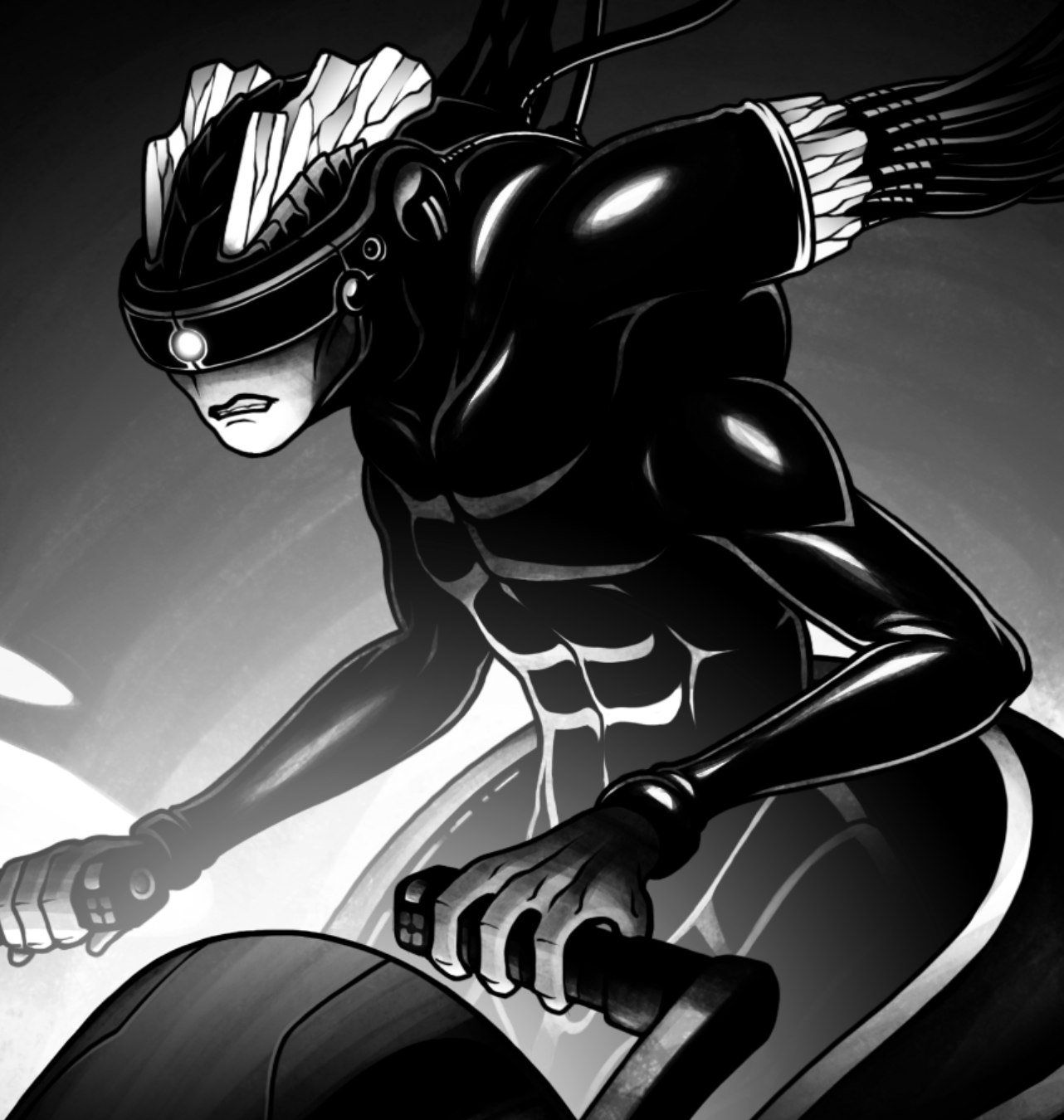
An Ar’tash in the cockpit of a Gauntlet. Note the crystal growths where limbs and horns have been amputated.
Artist: Blazbaros
Recovery itself forms part of the selection. Candidates are subjected to prolonged physical and psychological trials while the interface develops, with mortality considered an acceptable component of the procedure. The nature of these tests differs between Havenholds. Recorded examples include feats of endurance, exposure to environmental extremes, and candidates being released into enclosed sections where packs of Coegie hunt them.
A Cal’kaan is less a vehicle than it is an extension of the Ar’tash in every sense of the word, and it is through these trials that they develop the skills required to perform their service. In broad principle, it resembles the concept behind Tetsudyne assault armor employed by the Barakan Elite: an armored system fitted around a biological operator to increase strength, mobility, survivability, and lethality, both integrated with a cogit-hood. The similarity ends there. Whereas a Barakan enters an assault-harness, an Ar’tash is permanently installed within his Gauntlet and cannot leave the essential core of the construct.
To date, the Ar’tash represent some of the most destructive technology encountered within this Exogen’s arsenal.
The Gauntlet
A fully integrated Cal’kaan functions seamlessly as a part of the biological nervous system of its Ar’tash. Gauntlets are modular machines and appear in several configurations according to the abilities of the operator and the requirements of the Migration’s leadership.
Their armor is covered by circular modular caps containing interchangeable sensor, computing, defensive, and mobility systems. Individual modules have been identified or are suspected to contain multispectrum detectors, trajectory processors, and gravimetric feedback systems, as well as countermeasure suites that fling glowing sapphire flares, solid-shot discus interceptors, and specialized navigational equipment that allow a Gauntlet to operate in and between any medium.
The Gauntlet’s most distinctive characteristic is its gravitic mobility system. Rather than relying solely on conventional thrusters, an Ar’tash can generate rapid bursts of localized gravimetric force, allowing the frame to move across a vessel’s hull, instantly change direction despite bone-crushing centrifugal force, or accelerate along virtually any available axis with remarkably little apparent concern for inertia. The Shigue understand gravitic manipulation more than any other species in Known Space and apply this technology across their civilization, but nowhere is it more acute than in the function of a Gauntlet.
The larger upper arms are used to traverse as well as smash or rip apart opponents in conjunction with the lower legs. Weapons mounted along the spine or shoulder area act independently from the limbs, but it is the finely-tuned systems operated by the mid-limbs which are often the most specialized in purpose.
Cal’kaan are capable of atmospheric flight, deep-void operation, and submersible deployment.
Servants of the Havenhold
During their traversal across the Galaxy, Gauntlets primarily fulfilled maintenance, engineering, recovery, and rescue roles. Initially, there was no need to engage them militarily in the defense of their people until their approach to the Galactic Core. The species therein, as well as the tumultuous gravitational forces present, forced the Migrations to augment that technology into the weapon of the present day, thousands of years later.
That said, the Ar’tash still busy themselves with the repair of the Migration. To the Shigue, preserving the Migration may carry no meaningful separation between industrial labor and warfare. Repairing the Havenhold and defending are simply different expressions of the same responsibility.
Weapons of the Ar’tash
Gauntlets have been observed carrying a vast array of weapons, many incorporating technologies that remain poorly understood by Directorate analysts despite understanding the function of the technology.
Heavy gravitic cannons are more than capable of violently altering localized forces against a target, rather than relying exclusively on conventional impact.
Centrifugal launchers fire explosive discus-like projectiles at extreme velocity, while other frames utilize wire-guided ordnance for precision attacks against vehicles, spacecraft, and fortified positions.
Perhaps most notable are the Gauntlet’s hard-light projectors, similar to the smaller units used by Warstriders, which generate large shield panel formations to protect the user as well as those behind or beneath it. Other programmed shapes include blade-like structures as well as more exotic creations, such as stylized horns and claws.
Countermeasure systems incorporated into the modular outer hull allow an Ar’tash to alter its defensive configuration according to mission requirements.
A single Gauntlet does not possess the raw strategic striking power of a Directorate fighter craft, but this comparison can be misleading. The Cal’kaan occupies the operational space between empowered infantry and aerospace vehicle. Against AMUs, Pocketsteel, or even Barakan, a single Gauntlet is exceptionally dangerous. Under favorable conditions, Ar’tash units have proven capable of destroying conventional Directorate assault vehicles and have the means to cripple Armada capital ships.
Their maneuverability makes them particularly dangerous in ship-to-ship engagements, where a Gauntlet can move across hulls, penetrate defensive emplacements, and attack critical infrastructure without behaving like any conventional boarding unit.
Coteries
Ar’tash do not normally operate alone.
Like all Shigue formations, there is emphasis on numerical operation.
Those who undergo installation and survive their trials together form permanent combat groups known as coteries. The relationship appears to extend well beyond ordinary military cohesion. Members remain together following transformation, inhabit isolated sections of their Havenholds, and frequently deploy as a single formation.
This is largely due to the exclusion the Ar’tash receive from the majority of Shigue society. Permanently stunted because of their transformation, their horns removed, upper arms and legs amputated, they hold absolutely no value in traditional culture. As such they form their own ‘herd’, so to speak, amongst themselves with their own customs.
They rarely communicate with Warstrider formations who, in turn, seemingly ignore them, even in combat situations. Instead of communication, both sides act and react to each other’s movements and outcomes almost as if the other were an act of nature or an rogue part of the battle field.
While coteries remain independent, they do maintain a particularly strong relationship with certain matriarchal Shigue, known as the Life Givers, responding to their direction with little visible hesitation.
Exactly how Shigue military cohesion functions remains poorly understood. Human military organizations depend heavily upon explicit chains of command, tactical communication, and constant transmission of orders from Patron to General to Tributary. Shigue formations frequently appear to require far less of it. Individuals simply seem to know what must be done, carrying out their role with little deviation.
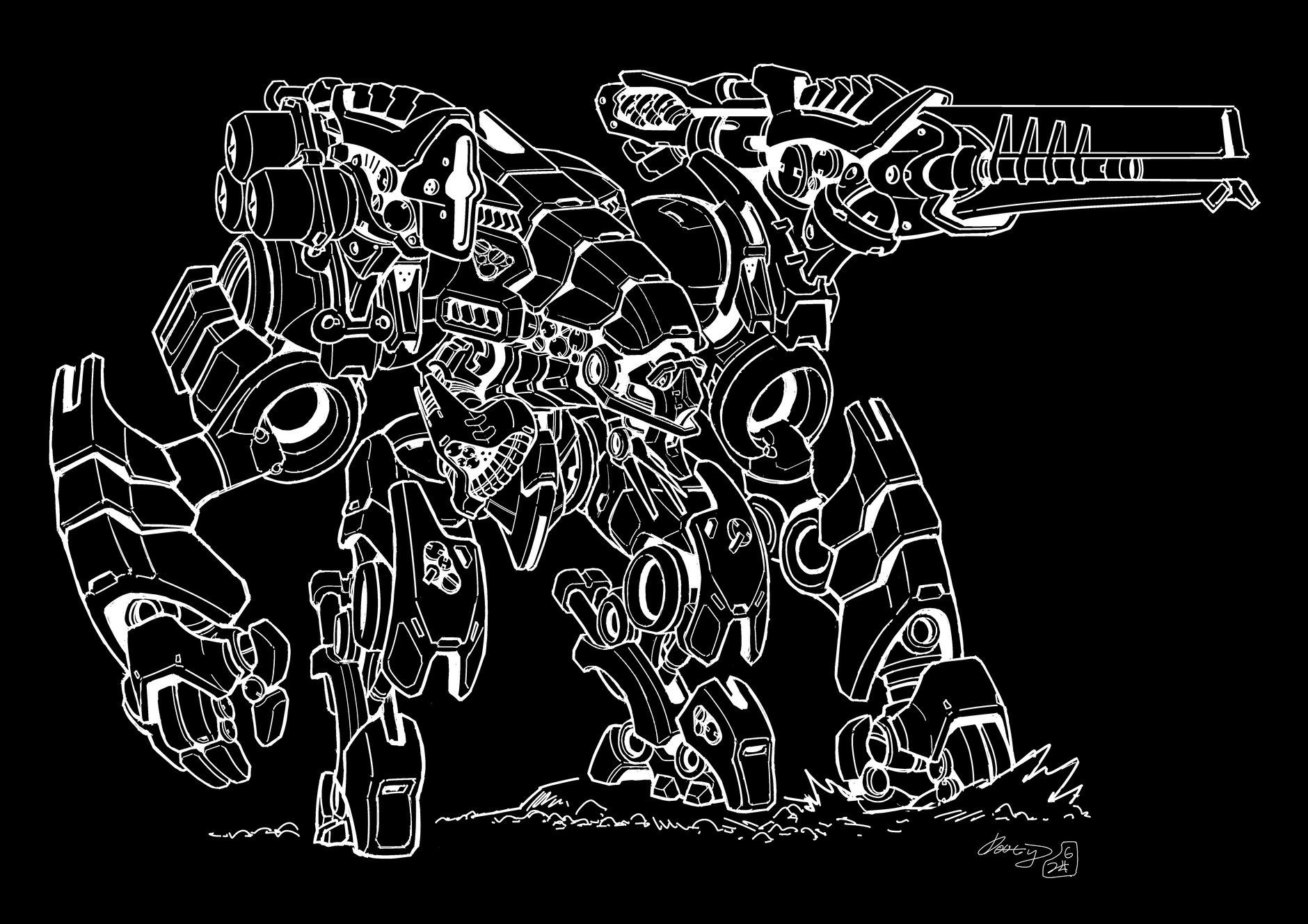
A heavier version of the Gauntlet with a gravitic culverin and a heavy discus launcher capable of launching explosive ordinance that can curve or serve as a mortar
Artist: Dooty
The Sacrifice
The status of the Ar’tash within Shigue society is deeply contradictory, but is disturbingly similar to how Barakan are perceived by the Hegemon. The Barakan are a mass casualty weapon rather than an elite formation of troops. They are treated as if they were an atomika-grade bomb, only with more delicacy. They were once human, of course, but now are no longer and cannot be considered as such.
Unlike other supersoldier creations like the Proxy Legions of the Myroit Empire who are elevated to positions of honor, or the Catraethi War-Monks who were worshipped as messengers from a higher power, the Shigue regard their provolved soldiery with a kind of enforced ignorance.
They are honored.
They are feared.
And they are pitied.
Once installed within a Cal’kaan, an Ar’tash has surrendered any conventional future within the herd. The Migrations exist around a promise they were made in ages uncounted. After generations of travel, death, and pain, the Shigue will eventually find a world upon which they can finally truly settle and be at peace, as they were before the coming of the Cataclysm.
The Ar’tash have no place in that promise.
Their bodies have been permanently altered for conditions that will no longer exist once the Migration ends, when thousands of millions of starships will be grounded and dismantled to build a new future. Their purpose is the preservation of the Havenhold and the tens of millions that lives within it. They are weapons and guardians built for the journey itself, but never intended for the destination.
Outside the regulating environment of the Gauntlet and its symbiotic interface, an Ar’tash remains developmentally suspended in a form of prolonged juvenile puberty. Only when their Piruq’tuq implants integrate with the Cal’kaan growths are they becalmed and can control their tendencies with regulation. While they will not speak of it, it is believed that each Ar’tash has a distinct relationship with the Piruq’tuq crystal matrix within their Gauntlet.
Within a Gauntlet, the impulsivity of a Yearling disappears and is replaced by a cold, methodical combatant. Their aggression lacks the explosive rage characteristic of many Warstriders or the wrathful indignation of Longhorns. Ar’tash eliminate threats with an almost melancholic efficiency, as though violence were simply another maintenance procedure necessary to keep the herd moving.
Their hostility toward Coegie is particularly pronounced. Ar’tash have been observed killing them with little or no provocation, possibly reflecting the use of Coegie during their initiation trials or some deeper cultural association yet to be understood. As such, the Coegie operate and live far from Ar’tash.
Ar’tash culture, as observed, is one of solemnity and duty, but comprehended through the mind of a tortured child. The extremes of youth never fade into the confidence and certainty of adulthood, their emotions sharpened to burning points trapped within the metal bodies of technological beasts. Accordingly, their customs are extreme, often including bloodletting, extreme deprivation, or debauchery to unheard limits amongst other Shigue.
Much of an Gauntlet can be stripped away, leaving the exposed body of the Ar’tash with seemingly few prosthetic elements. Even so, the Ar’tash remain in their own isolated parts of the Havenhold, and do not permit their naked bodies to be seen by other species nor their former kin.