
The Union’s Muscle
We have a double miniature release this month!
The Labour Mobility Unit has an awesome design, thanks to sculptor ThatEvilOne and concept artist Dooty, as well as an up-armored version featuring heavier weapons.
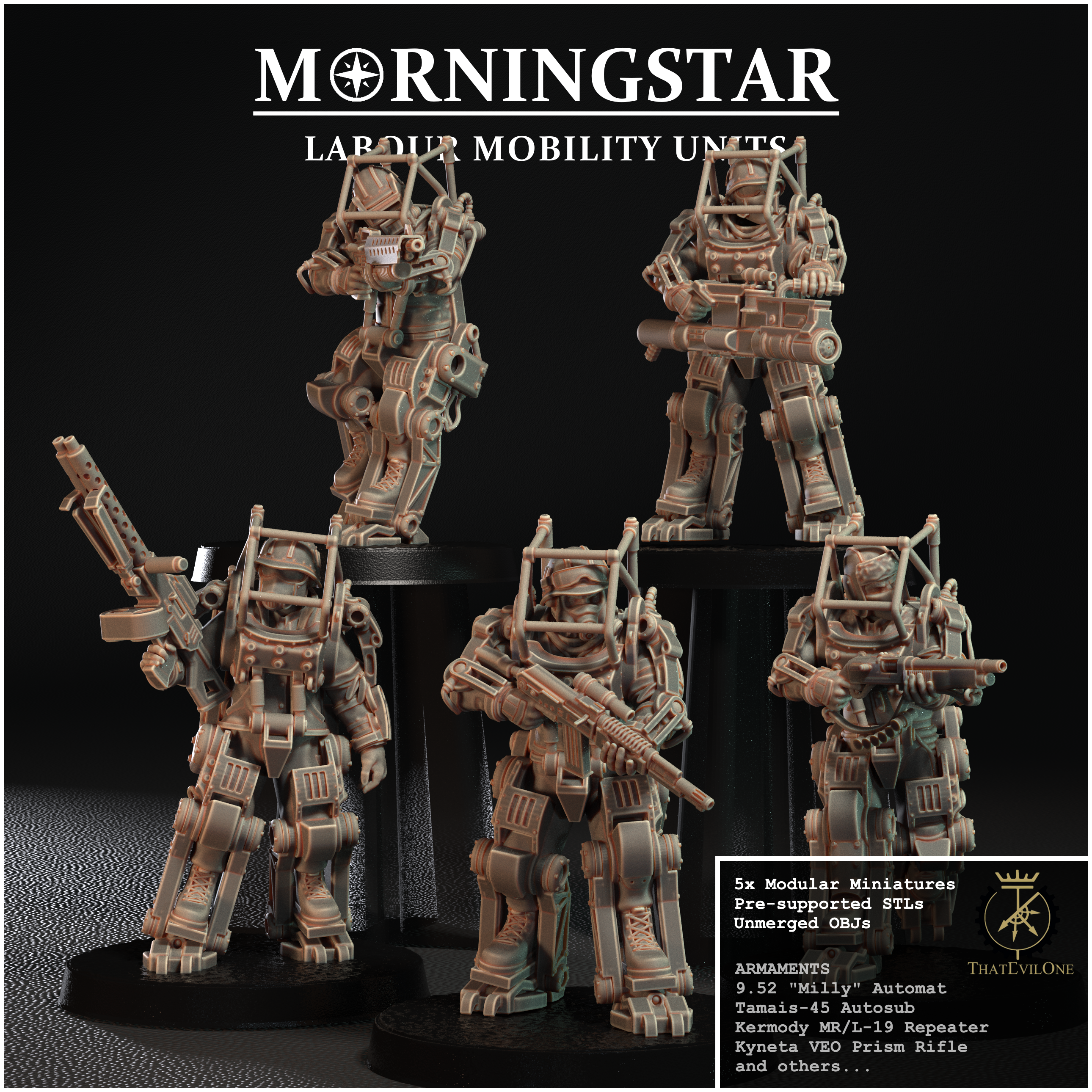
Originally built for industrial functions, these repurposed LMUs allow Unionist fighters to go toe-to-toe with the sleeker pocketsteel armored exoskeletons of the Directorate, equalizing the playing field.
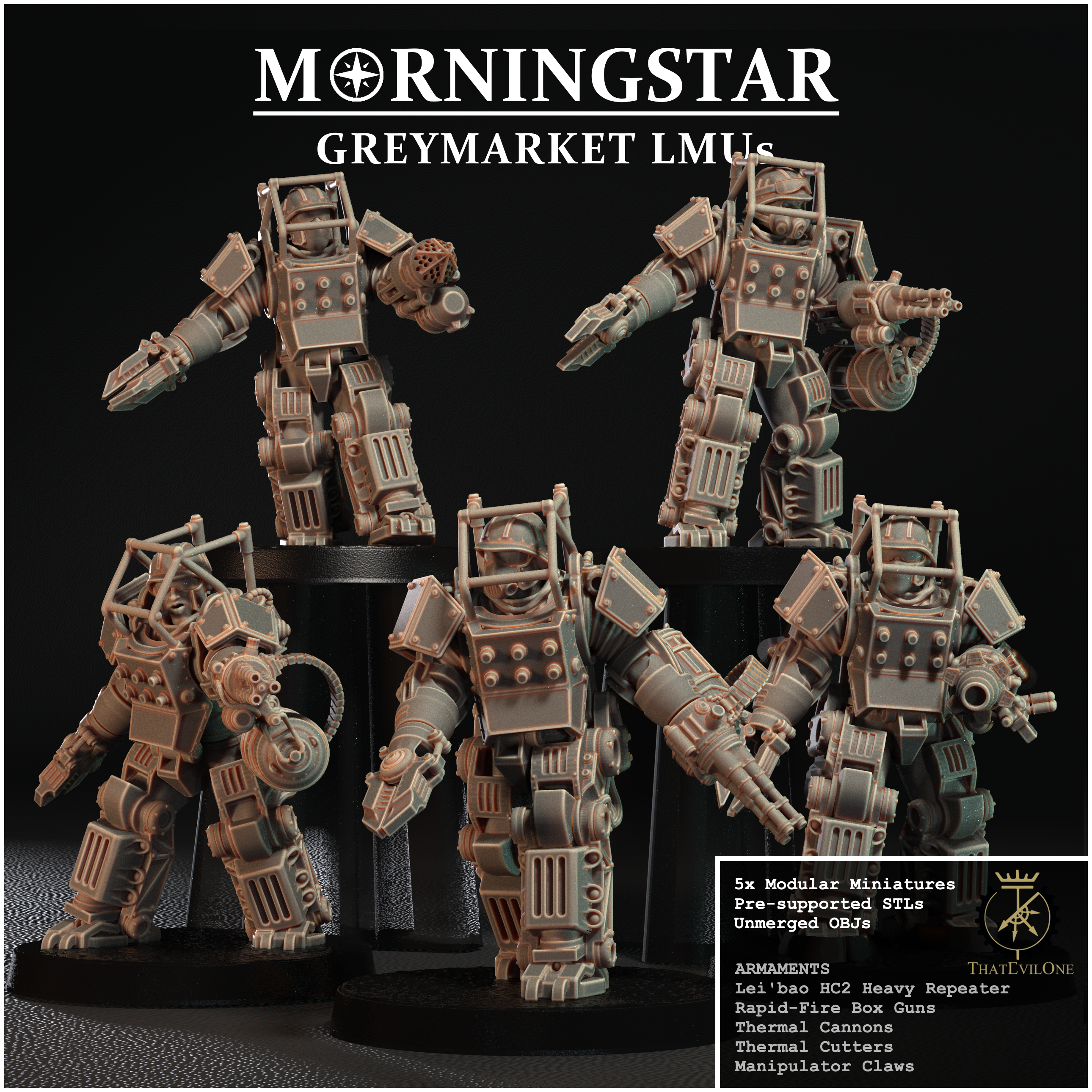
Greymarket LMUs boast improved power sources and can support weapons pilfered or manufactured from captured manufactory schematics, in addition to being reinforced by improvised armor panels.
Both miniature sets are available for purchase through our affiliate stores and partners after September 4th:
https://projectmorningstar.net/miniatures/
The STL files are available for our Consumers, Barakan, and Magnate tier supporters on our Patreon, who receive new models every month:
https://www.patreon.com/c/morningstarproject
And now… the part you’ve all been waiting for, (hopefully) LORE!
Labour Mobility Unit
Classification: Industrial Auto-Harness
Common Nicknames: LMU, “Lifter,” “Yardarm,” “Can”
Operations: Heavy construction, freight handling, industrial recovery
Modified Role: Improvised heavy infantry platform
The Labour Mobility Unit, commonly abbreviated LMU, is an industrial auto-harness designed to allow a human operator to lift, carry, and manipulate loads measured in thousands of kilograms. LMUs are employed wherever conventional machinery is too cumbersome or insufficiently precise: orbital shipyards, construction sites, freight decks, mines, or disaster zones. Unlike pocketsteel, an LMU is not worn as armor. The operator stands within an open mechanical frame, secured at the torso, pelvis, forearms, and legs, while the machine reproduces their movements through a system of empowered limbs, utilizing fissile fuel or powercells.
Most LMUs use myomeric compression bundles arranged around key motors mounted on a nusteel load-bearing skeleton that is manipulated through the wearer’s movements, requiring extensive training so as to not incur accidental self-injury or death. These artificial muscles contract in response to pressure changes within sealed electrofluidic channels, providing greater lifting strength than conventional rotary motors while remaining comparatively easy to repair. A wearer can safely manipulate between one and three metric tonnes, although the frame can briefly support considerably more with a skilled user.
The operator controls the exoskeleton through a somatic relay harness that reads muscular tension before the body completes a movement. This ensures an almost instant response from the LMU. Properly calibrated, the auto-harness feels less like a suit than an enormous extension of the body and with proper training a wearer can operate with agility. Poor calibration produces the characteristic “yardarm stagger,” in which harness and user lurches, overcorrects, often causing physical harm. Industrial models therefore incorporate governor blocks that limit acceleration, grip pressure, and joint rotation. Worksites commonly require operators to pay for and complete a certification program before getting an assurance policy.
A reinforced roll cage protects the head and torso from falling debris, while plastalloy shield panels can be fitted for work in mines, foundries, or low-pressure environments. The frame’s arms terminate in interchangeable labour heads, including articulated hands, cargo clamps, cutting torches, impact drills, cable spools, and cutting claws. Its power source is usually a rugged short-cycle cell intended to operate for six to ten hours before replacement, although this is easily replaced. Nearly every component is designed to be accessible with common industrial tools, making LMUs particularly valuable on frontier worlds where specialized maintenance services are unavailable.
Unionist Black and Greymarket Conversions
Unionist uprisings frequently convert LMUs into rudimentary equivalents of pocketsteel. Their widespread usage, in preference over ergoid synthan labour, means the LMU is quite literally on almost every planet and station in the Hegemon, and has been adapted in some capacity across the majority of non-Hegemon-aligned states.
Civilian governor blocks are removed, and subscription limitations are circumvented by skivers, bringing the LMU’s capabilities closer to pocketsteel levels of mobility and reaction times. The roll cage is reinforced with nusteel, and the exposed electrofluidic lines are protected behind overlapping armor panels. The resulting machine is slower and less responsive than a purpose-built assault-harness, but strong enough to breach barricades, overturn vehicles, and withstand incoming fire.
The most extensive conversions replace the civilian powerpack with a greymarket surge source, often velanite if available, capable of supporting weapons salvaged from the Directorate. Common additions include industrial autocutters, rotary automat cannons, rocket pods, and flame projectors, to name a few.
These modifications are dangerous. An upgraded LMU lacks the inertial compensation and automatic trauma protection functions found in purpose-built harnesses, and most importantly, the neural connections necessary for full integration. Sudden acceleration can dislocate the operator’s joints, while reconfigurations are done without the manufacturer’s warranty. Overcharged myomer bundles have also been known to contract without warning, breaking limbs or folding the operator into the harness. Unionist techanics accept these defects as the price of transforming abundant industrial equipment into empowered soldiers.
Directorate personnel typically dismiss such machines. The contempt rarely survives first contact. In dense settlements, mines, freight terminals, and manufactories, the environments for which the LMU was built, a converted unit can move through industrial access ways, exploit terrain, and use the surrounding infrastructure in conjunction with their armor. What began as a machine for raising cities can, with surprisingly little alteration, be used to smash them apart.