
Pirates of Morningstar
As we gear up for the Backerkit for the Avarice RPG, I wanted to share details about some of the goons you’ll be going up against on Kandia. I’ve always liked pirates every since I was a little kid and my dad brought me on set to this pirate movie he was making. Before that my favorite book was Treasure Island, so when I started writing the Index and the foundations of Project Morningstar, I was happy to introduce our own take on pirates into the setting!
~ Boman (aka: Mr. Greebles)
Piracy has existed for as long as commerce has moved between the stars. Trade lanes, the means of which vital resources reach developing colonies, or refined products arrive to customers upon the ancient home worlds of humanity, have and will always be a target. Beyond the orbits of nations, the emptiness between worlds and stars alike remains lawless. The resources that it takes to keep even a single person alive in the Black are colossal, but the cargo that they carry is all the more so valuable. Every vessel made is a worthy target.
The desperation of survival across Known Space is so great that few question where the water, air, food or any of a thousand necessities for continued existence come from, regardless of the laws that attempt to govern the impossible. Black and greymarkets exist across the Thousand Empires, and it is the pirate that fuels them.
The popular image of the pirate is that of a raider operating beyond Civil Space, preying on MacroCorp freightliners and living lives of adventure. The entertainment conglomerates managed by Riegan-Marg Ventures have made them both heroes and villains, depending on the social trends at the time. The image of a pirate captain, an outlaw of the stars, descending upon colonial settlements or isolated vessels before escaping into asteroid fields or into the unknown, is certainly romantic to the Grounder as much as it is terrifying to the Orbiter. Such pirates certainly exist, but they represent only the most visible edge of a much larger society. Most successful pirates are not indiscriminate marauders. They are contractors, smugglers, privateers, salvagers, and armed merchants whose legal status changes according to where they are standing and who presently requires their services.
A crew declared criminal by one polity may be retained by another as a deniable naval asset. Captains earn their place back as licensed operators in the Hegemon, and sacrifice those contracts when an opportunity is too good to pass up. While space is big, the MacroCorps’ memories are long, and a rare few pirates must exist on the Fringe alone, hunted by Directorate, skiptracers, and their fellow pirates hoping to fulfill a bounty.
The Business of Piracy
Few pirate vessels survive by hunting cargo alone. Ships require fissile fuels to power their furnaces, any number of replacement parts, and possibly the most valuable resource of all: information.
Pirates must know which ships are traveling, what they are carrying, where they will ascend along a leyline back into realspace from the Outside, and whether someone is prepared to purchase the cargo afterward. The seizure itself may be the shortest and least complicated part of the enterprise, but then, violence typically is when in the Black.
It is important to remind one that combat in space, even against Exogen, stops at the point at which a vessel is crippled. The actual destruction of a starship represents such an egregious loss of value that no sane species would seek total annihilation. As such, there is always something to scavenge, although actual life, which is just another pair of lungs to fill and a mouth to feed, is rarely a priority.
Piracy depends upon a considerable supporting industry, despite its nature as an illegal operation, requiring a vast panoply of individuals stretching far beyond the colorful buccaneers. Promoters arrange introductions between captains and prospective clients, who must always be wary of Hegemon officials and their lapdogs in local government seeking to enforce the Lex. Port workers and stevedores are needed to amend registries or delay inspections. Techanics and skivers both are needed to alter manifests and ownership records. obfuscating the truth for the inevitable skiptracers who will be sent to uncover what happened to the property of their patrons.
As such, any theft of any item from the tradelanes requires the consideration of how it can be resold. Most goods must eventually re-enter regular commerce, since Frontier colonies often are unable to meet the price points needed to make them worthwhile to haul to. Thus, the real profit remains in the Civil Space.
Manufactured components can be stripped of their serial identities and treated to make investigation too difficult to pursue. Resources like water or food are easily blended with legitimate supplies, and entire ships can be broken down to their consummate parts to make new ones. As to the biological factors of a starship, well, passengers are easily ransomed or even recruited. More often, they are sold into forced indentured contracts and even slavery beyond the borders of the Hegemon.
The most prosperous pirate captains therefore resemble Executors more than brigands, and they are not without their own customs, codes, and social prerogatives. They negotiate contracts, maintain the accounts and subscriptions needed for their vessels, but also cultivate key political relationships. Their first job is, always, the management of their crews. Pirate caeliners are often deserters or hardened criminals who pursue Avarice with such abandon as to be called baseborn and greedy. To lead such people requires regular payment as well as the careful application of opportunity, and at any time a captain may be challenged through subterfuge and mutiny, or by traditional duels.
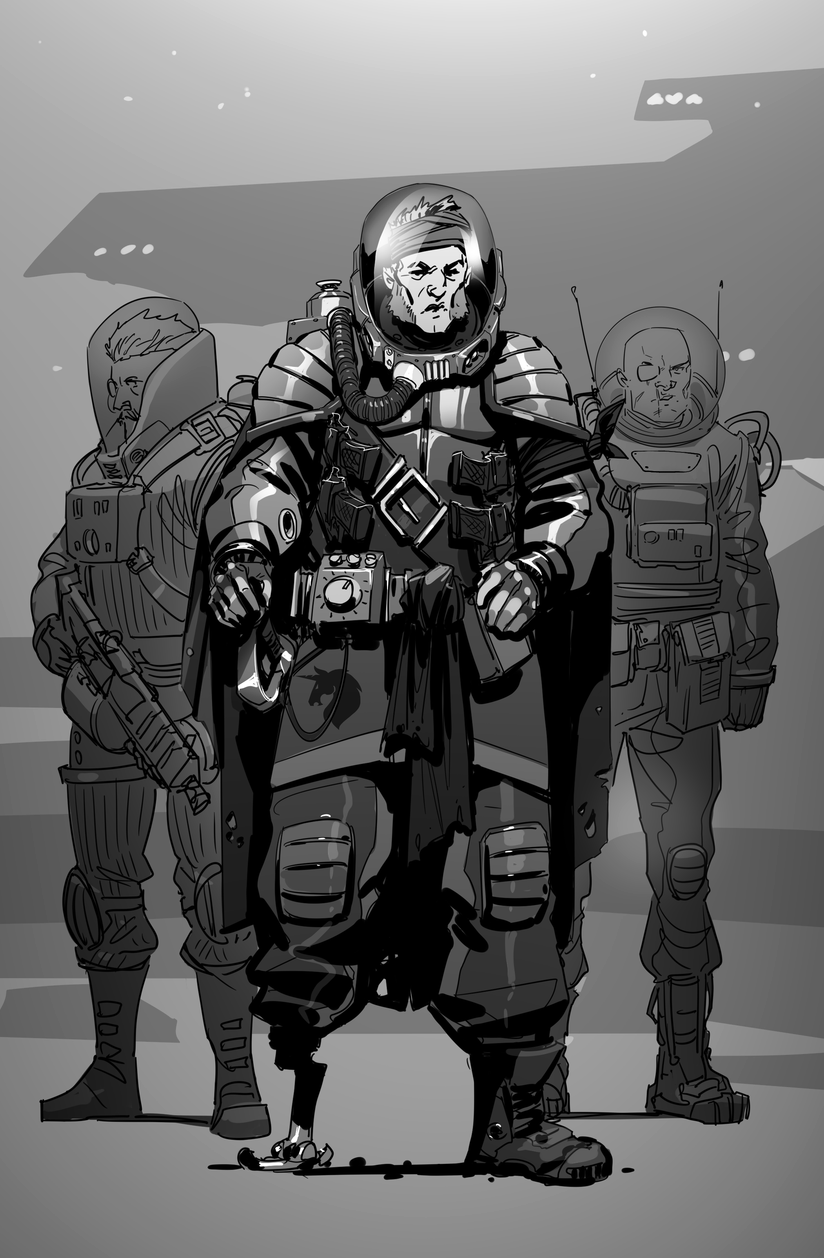
Members of the Morgana Privateers, an affiliated crew with the Mehndax, arrive on Kandia seeking a means to sell a stolen mithqal‘s worth of Cerulean Rippocha bricks they acquired from a freightliner leaving the planet Sedoor.
Raiders, Mercenaries and Privateers
The distinction between piracy and mercenary work is frequently a matter of documentation.
MacroCorps, planetary governments, and the Hegemon’s military all require operations they cannot officially acknowledge. Pirate crews can harass competitors, seize proprietary materials, recover escaped personnel, or undertake any number of clandestine missions that can be dismissed with plausible deniability. Because they possess their own ships and weapons, they can be retained without the expense or political consequences of deploying formal forces.
Some crews accept defensive contracts, escorting those who must traverse dangerous systems and protecting them, often, from their own kind. Many of these more seemingly altruistic captains fight against the all-too-real injustices of civilization by rescuing populations from slavers, or by running vital supplies through blockades into warzones. The licensed war launched by Suns Confederated in the mid 9th fiscal-century against the Arkadian nation of Kanatha was notable for attracting not only mercenaries from across the Thousand Empires, but also the self-styled “Grand Admiral” Azumakabe, who worked for free against Suns Confederated.
While this sounds well intentioned, there is always value in anything a privateer does. Azumakabe became so wealthy preying on Suns Confederate supply lines that he now owns an estate on Lhunarca, despite being a low-born Fringer.
A crew or captain may perform acts that are both honourable and predatory within the same fiscal cycle. Pirates are not united by a common ideology, but by the same thing that binds all human societies: need. Some are desperate or indebted spacers, and many are former Directorate personnel who mutinied. Others are professional raiders who regard every unprotected ship as an invitation.
Their one shared communality is that they do not play by the rules that society has enforced, but only with their wits and whatever loose collection of rules local to their individual ship to keep the engine running and the air pumping.
Piracy Through the Fiscal Centuries
Piracy is older than Civil Space itself. During the Hegemon’s first period of expansion from the Protean, Jov, and Trappist systems, its newly adopted tradelanes were continually attacked. This was predominantly perpetrated by anti-Hegemonic forces paid by the opposition nations of the time, like the Kantaur Dominion, but also by the various Exogenic threats that still infested the Cradleworlds of Old Humanity and what would one day be christened the ExeCor of New Mankind.
In response, the Hegemon formed a combined military of all its worlds, now known as the Directorate, to defeat these threats. In true Hegemonic fashion, pirates were often negotiated with, at least the human (enough) ones, and countless pirate captains and crews became apart of the growing Armada. Those who would not were either driven from the region or reduced to debris among the stars.
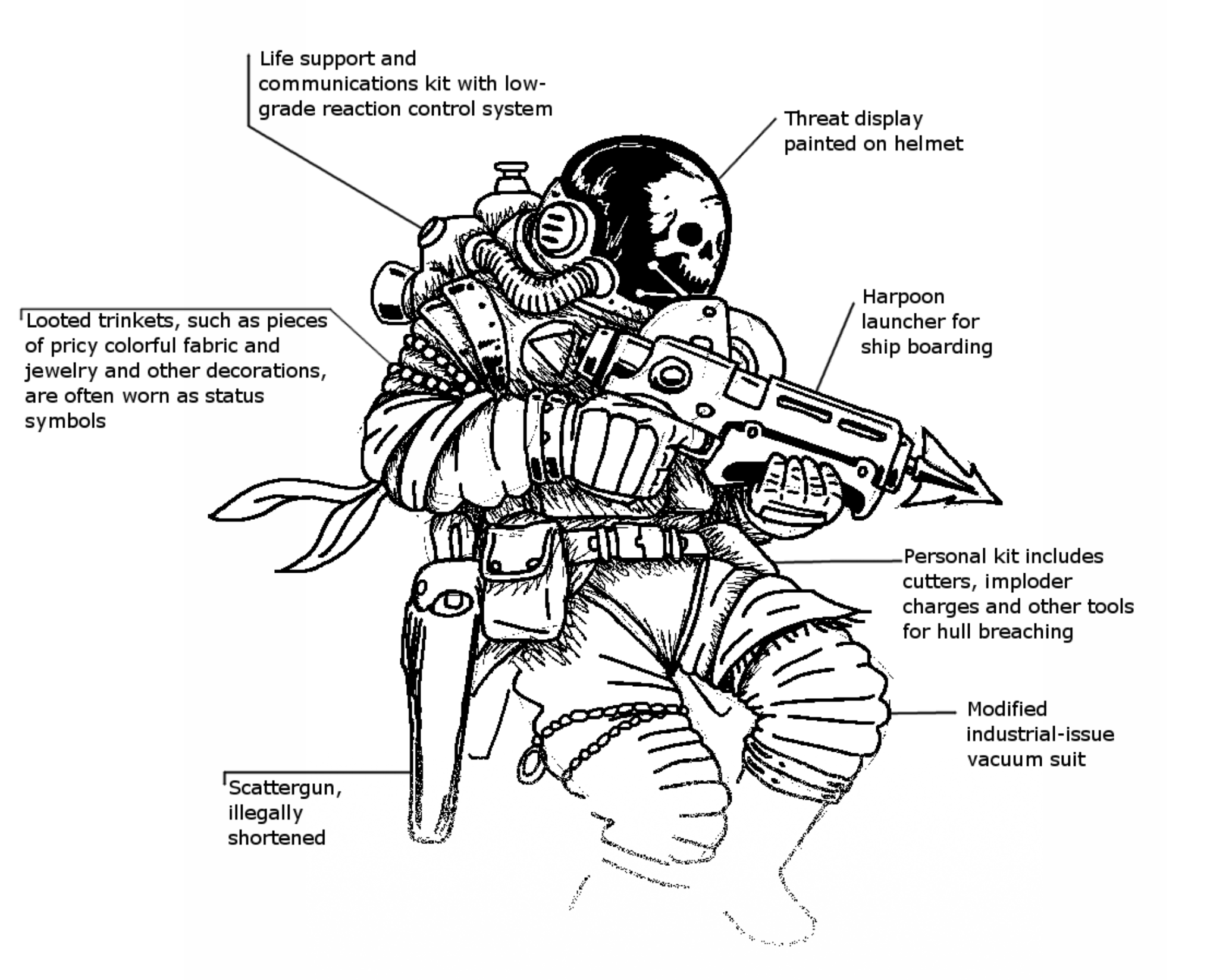
Artwork by Joazzz
What would eventually be called Civil Space was therefore not naturally peaceful; it was produced through millennia of constant patrols, sieges against pirate hideouts, and commercial warfare.
Pirates have repeatedly appeared during periods of wider instability. During the Attack on Trasimaen in 2/17-067 by the Catraethi Regenium, pirate forces struck from the Frontier in the same quat when the Hegemon was weakest. Refugees fleeing from the wreckage of the worldring Cortona were sold into slavery, and the treasure of that fabled mega structure was plundered. What’s more, the subsequent armed uprisings and Exogenic incursions that occured at the same time led the Audit to conclude the existence of a coordinated conspiracy against the Hegemon, never mind the encroaching invasion by the Regenium.
The greatest recorded campaign against human piracy began with the Orion Corsair War of 3/04-013. Largely considered a reciprocal attack, as the Regenium had already been defeated, the Orion Corsairs were the largest and most organized fleet of pirates in Known Space, and it would take a full fiscal decade to root out their many bases in the Cygnus-Orion Spur. The Directorate declared the region pacified only after besieging the pirate strongholds within the Clew Asteroid Belts. While this did not outright defeat this dynasty of piratical lords, it did decapitate their leadership and slow their operations for over a century.
Piracy has occasionally advanced the Hegemon’s interests by accident. In 4/48-190, the Muskovak Tributary Armada attempted to avoid piratical forces near the Shoulder of Orion and inadvertently discovered a passage into the Perseus Arm, which had remained cut off from exploration. The resulting leyline confluence became known as the Gates of Orion, producing a worldrush and opening an entirely new Frontier to commercial exploitation by MacroCorps and independent outfits alike. An attempt to evade pirates consequently became one of the Hegemon’s great acts of expansion.
The most infamous modern pirate movement began in 9/03-010, when Talan Hod resigned as the Archonist Magnate of Wanvath Underwriting. Taking a fleet of mercenaries with him, Hod ransacked a Bersarang depot on Narada before conducting precision raids against dozens of other MacroCorp holdings throughout the ExeCor and Midworlds. His knowledge of internal revenue and corporate operations catapulted him to the number one criminal in Known Space.
Hod distributed much of what he stole among impoverished colonies and outposts, for free. Their support helped him evade Auditors and skiptracers until he disappeared into the Mehndax sector. There he established the Eye of Hod and the effective corsair republic known as Mehndax, a ‘nation of pirates.’ By the close of the 9th fiscal century, his forces represent a threat across the entire Hegemon, with calls growing for the Barakan Elite to be deployed against them once and for all.
Pirates have also become participants in the Hegemon’s information wars. During the Great StrikeBreak of 9/71-282, pirate broadcast stations distributed images of the uprising throughout the Eastern supersectors. Their involvement helped transform a regional labor revolt into a spectacle capable of capturing widespread public attention. Conversely, when isolated populations vanished during Bad Echo in 9/85-340, the Mehndax were blamed despite the physical impossibility of their fleets crossing the Directorate’s defensive lines.
Piracy is consequently more than the robbery of starships. Pirates have acted as insurgent allies, mercenary fleets, smugglers, propagandists, political scapegoats, and accidental agents of expansion. The Directorate may suppress individual organizations, but the conditions that create them remain embedded within the Hegemon’s economy that, in turn, both benefits and suffers from them.

The threat display of the Pirate is unique to each vessel and fleet, serving as a signature of a captain or dynasty. Often they will be fearsome, instilling fear, dread, and peril to those who see it. The above symbol is that of the now-reduced Orion Corsairs, who once plagued the Midworlds. Many captains still broadcast this symbol, whether apart of the original dynasty or not, and it still retains the desired effect.
Pirate Vessels
Most pirate ships were built for another purpose. Freightliners, quickships, tenders, cutters, and obsolete military craft are refitted according to whatever equipment their crews can steal, borrow,or invent. Most importantly, these vessels must hide what they are. An Armada vessel that scans a ship and detects volatile explosives, or modified thruster arrays that could output far beyond what is licensed, will pursue immediate interception. As a result, most pirate vessels spend as much on baffling and jamming equipment as they do on weapons.
Pirate vessels rarely defeat Directorate warships or mercenary security vessels in a direct engagement. Their advantages are uncertainty, preparation, and speed. Often, a pirate attack will make its presence known, eliminating a smaller ship or firing warning shots, and a freightliner captain or passenger ship will simply transfer funds or part of their cargo, and suffer the penalties of their assurance subscriptions and wrath of their patrons – but it beats the alternative. If the pirates believe there is more to be gained, they will initiate boarding actions, which are often savage, but quick, affairs intended to cow the caeliners of their victim ships. Very rarely will pirates scuttle a craft and eliminate the crew, but it does happen.
It should be noted that the Mehdax pirates show no fear of the Armada and will brazenly engage with the Directorate, often trading a few volleys of long-range missiles and executing daring flybys before disappearing into the Black.
Pirates on Kandia
Kandia stands at the heart of the Hegemon, but this does not make it free of pirates. It makes the planet indispensable to crews both large and small.
Thousands of ships arrive and depart this true ecumenopolis each day, bringing passengers, raw materials, and commercial traffic, while they are passed by other transports leaving with refined goods and manufactured products. Millions of travelers pass through its official ports, while uncountable thousands slip through the cracks by arranging landings in any number of private or illegal harbors. It would take the direct focus of an entire mindworld to perfectly account for that volume of people, and the rigid pro-humanism of the ExeCor would never allow that. As such, criminals and pirates both move relatively free of suspicion, as long as they do not wear their true identities on their sleeves.
Still, the Lawkeepers of Kandia are dogged in their mandate to keep a planet of trillions of Consumers orderly, and they actively seek out any that would disrupt that pursuit. The Kandian government regularly employs Forfeits, criminals deemed too important to rot in a hellscraper in the Exilar system. Now turned into licensed hunters, they often have direct relationships with the people they now hunt.
But it’s worth it. Kandia is where the contacts are for the entire ExeCor.
Promoters, advocates, and pirates themselves will visit the planet to negotiate contracts directly, as well as to recruit specialists. It is also an ideal place to sell, or ransom back, the best and choicest items stolen. With Kandia being a nexus of ansible arrays connecting hundreds of planets to a single communication hub, it is also the best place to intercept ship movements throughout Civil Space, saving outfits the labour of idling around leyline points, waiting for a ship to emerge from the Outside.
Kandia also offers unique supplies on a scale unavailable to most Frontier ports. A crew can obtain industrial components without revealing that they are intended for a warship, while weapons can be purchased through readily available intermediaries. Injured personnel can receive vital Grade 1 health treatments. If these items cannot be acquired in the upper levels, untold, albeit dangerous, opportunities exist in the Substrates.
Not all pirates are in hiding. Indeed, the criminal of the Fringe can easily be the toast of the spire in the ExeCor. Many Corpos like to moonlight as ‘dangerous’ individuals beyond the scrutiny of Civil Space, enjoying a manner of vacation from their responsibilities. They spend their earnings, visit family, seek medical care, and enjoy the city of cities. With stable Gatewells, they can even use Kandia as a chance to travel to other planets in the ExeCor.
The Kantauri Compact, the multi-party system that governs the Kantauri systems and influences a dozen others, tolerates none of this officially. Lawkeepers pursue known offenders, customs authorities seize prohibited cargo, and the Directorate destroys crews that threaten major commerce. And yet, Kandia’s size makes total control impossible, while its economy ensures that someone will always profit by looking elsewhere.
A Necessary Enemy
The Hegemon depicts pirates as enemies of commerce and, by extension, enemies of every Consumer whose livelihood depends upon it. This is often correct. Pirates murder people, seize property, ransom passengers, and strip isolated settlements of resources they cannot replace, while selling their populations into slavery.
Every raid increases freight costs, assurance subscriptions, and the taxes required to finance Directorate patrols to deter repeat attacks. Even those who never leave their homeworld eventually pay for piracy.
Yet the Hegemon produces the very enemy it condemns.
Every quat, military contracts expire, releasing armed and augmented combat-experienced personnel into the CorpoSoci that may have no further use for them. The Directorate trains these individuals to kill, places them aboard starships, and teaches them how Hegemonic security operates, only to treat their eventual departure as an accounting matter. Some find legitimate employment as sanctioned mercenaries. Others discover that their weapons, contacts, and operational knowledge possess greater value outside the Lex.
There is profit in allowing the process to continue.
Piratical activity has the ultimate effect for creating demands for weapons and security. They provide MacroCorps with deniable muscle and isolated colonies with protection that licensed forces cannot, or will not, provide for whatever official reason. They can act as heavily armed smugglers, or be unleashed upon designated targets. Once their usefulness ends, the very same pirates can be publicly hunted, imprisoned, and displayed as proof that the CorpoSoci protects its Consumers.
Pirates therefore occupy the profitable separation between what the Hegemon prohibits and what its members are willing to purchase. They are condemned when they obstruct commerce, contracted when they advance it, and forgotten whenever convenient.
In the end they aren’t really an enemy of the Hegemon.
They are just another one of its products.